Report · Digital edition
Biodiversity Loss and Ecosystem Degradation
Tipping Points, Biosphere Integrity Breach, and the Cascading Failure of Planetary Life-Support Systems in the Polycrisis Apocalypse
Abstract
Biodiversity loss and ecosystem degradation are frequently mischaracterized as secondary conservation concerns subordinate to decarbonization. In the crucible of the twenty-first-century polycrisis, the biosphere functions as the fundamental operating infrastructure of planetary stability. According to the Stockholm Resilience Centre and the Intergovernmental Science-Policy Platform on Biodiversity and Ecosystem Services (IPBES), the Biosphere Integrity planetary boundary has been severely transgressed, with global vertebrate populations plunging 73% since 1970 and contemporary species extinction rates exceeding pre-industrial background baselines by several orders of magnitude. Rather than experiencing gradual, predictable decline, Earth's foundational biomes—including the Amazon rainforest, warm-water coral reefs, and boreal taiga—are approaching catastrophic hysteresis thresholds where climate anomalies and habitat fragmentation compound into self-sustaining collapse. This monograph delivers an empirical evaluation of ecosystem degradation across five focused chapters, five visual exhibits, and a master comparative biome dataset, outlining a capital-backed strategy for 30x30 spatial protection, natural capital accounting, and regenerative transition.
- 5
- Chapters
- 5
- Exhibits
- 1
- Data tables
- 15
- References
Key insights
- Biosphere Integrity is the most severely transgressed planetary boundary. The Living Planet Index confirms a 73% average decline in monitored vertebrate wildlife populations between 1970 and 2026, with freshwater ecosystems suffering an unprecedented 85% catastrophic collapse.
- Extinction velocity exceeds Holocene baselines by 100 to 1,000 times. Over 1 million animal and plant species face near-term extinction, transforming a stable geological epoch into an anthropogenically forced Sixth Mass Extinction event.
- Degraded biomes mutate from net planetary cooling buffers into ferocious carbon sources. Deforestation and drought have reduced the Amazon's atmospheric moisture recycling by 34%, pushing 38% of the basin into an attritional fire-driven degradation regime.
- Critical biophysical services underpinning human survival face functional dissolution. Insect pollinator loss endangers $577 billion in annual crop production, while the destruction of 50% of coastal mangroves exposes 100 million people to unchecked oceanic storm surges.
- The Dasgupta Review framework demonstrates that economic growth accounts fail to price natural capital depreciation. Annual ecosystem service losses will exceed $8.1 trillion by 2040 (7.2% of projected global GDP), generating sovereign rating downgrades across agricultural and frontier markets.
- Achieving the Kunming-Montreal 30x30 target requires legal recognition of Indigenous land tenure. Indigenous territories harbor 80% of remaining terrestrial biodiversity; securing their sovereign boundaries is the highest-leverage intervention to prevent global biome collapse.
Chapter 01The Sixth Mass Extinction: Transgressing Biosphere Integrity
The Biophysical Substrate of Planetary Stability
Within the analytical architecture of the polycrisis apocalypse, climate heating and resource depletion command overwhelming geopolitical attention. Yet ecological science increasingly demonstrates that biodiversity loss and ecosystem degradation represent the ultimate non-linear tripwire of Earth system collapse. The Stockholm Resilience Centre's planetary boundaries framework identifies Biosphere Integrity as one of two fundamental core boundaries—alongside climate change—upon which all other planetary boundaries depend. While climate volatility alters the thermodynamic state of the atmosphere, the biosphere regulates the chemical, hydrological, and biological cycles that prevent runaway planetary disequilibrium.
Today, that regulatory mantle is disintegrating. The 2024–2026 Living Planet Index synthesis reveals a staggering 73% average decline in monitored vertebrate populations over the past five decades. This biological hemorrhage is distributed unevenly across Earth's major realms: freshwater ecosystems have collapsed by 85%, terrestrial wildlife populations have fallen by 69%, and marine ecosystems have declined by 56%. These numbers do not merely denote disappearing species; they signify the systematic dismantling of the food webs, nutrient loops, and genetic reservoirs that have maintained Holocene stability for eleven millennia.
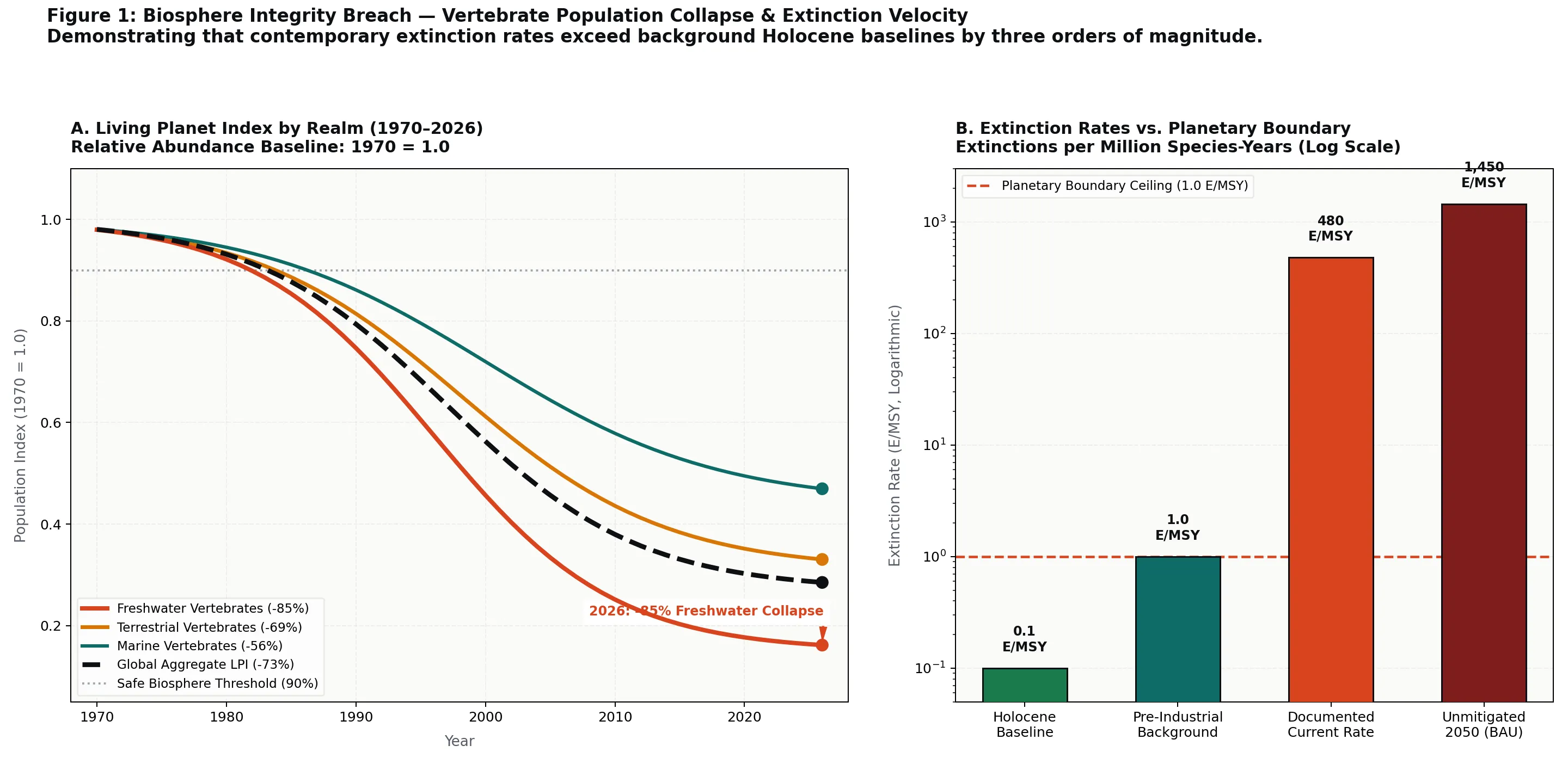
As illustrated in Exhibit 1, the rate of species extinction now exceeds the pre-industrial Holocene baseline by two to three orders of magnitude. The planetary boundary safe operating space is defined as an extinction rate below 1 to 10 Extinctions per Million Species-Years (E/MSY). Documented contemporary extinction velocity has reached 100 to 500 E/MSY, with unmitigated business-as-usual trajectories projecting rates exceeding 1,400 E/MSY by 2050. Over one million animal and plant species face near-term extinction. Human industrial metabolisms have altered 75% of Earth's ice-free land surface and 66% of its oceans, converting living natural capital into disposable agricultural monocultures and synthetic infrastructure.
Chapter 02Compounding Micro-Amplifiers: Soil, Pollinators, and Coastal Barriers
The Microscopic Collapse of Macroscopic Services
The tragedy of ecosystem degradation is rarely experienced as a single catastrophic shock; rather, it manifests as an insidious dissolution of micro-scale ecological services that quietly subsidize global industrial civilization. Standard economic accounting treats pollination, topsoil regeneration, and coastal wave attenuation as zero-cost externalities. In the polycrisis era, the attrition of these micro-services operates as an aggressive risk amplifier, transforming manageable meteorological stress into agricultural and demographic emergencies.
Consider the crisis of invertebrate pollinators. More than 75% of leading global food crop types—including fruits, vegetables, nuts, oilseeds, and coffee—rely directly on animal pollination. The widespread collapse of wild insect populations, driven by neonicotinoid pesticides, habitat destruction, and climate whiplash, directly threatens $577 billion in annual agricultural output. In intensive agricultural belts across North America, Europe, and East Asia, honeybee colony collapse and native bumblebee extirpation have reduced fruit set ratios and forced growers into expensive artificial pollination logistics, driving up agricultural operating costs while reducing crop nutritional density.
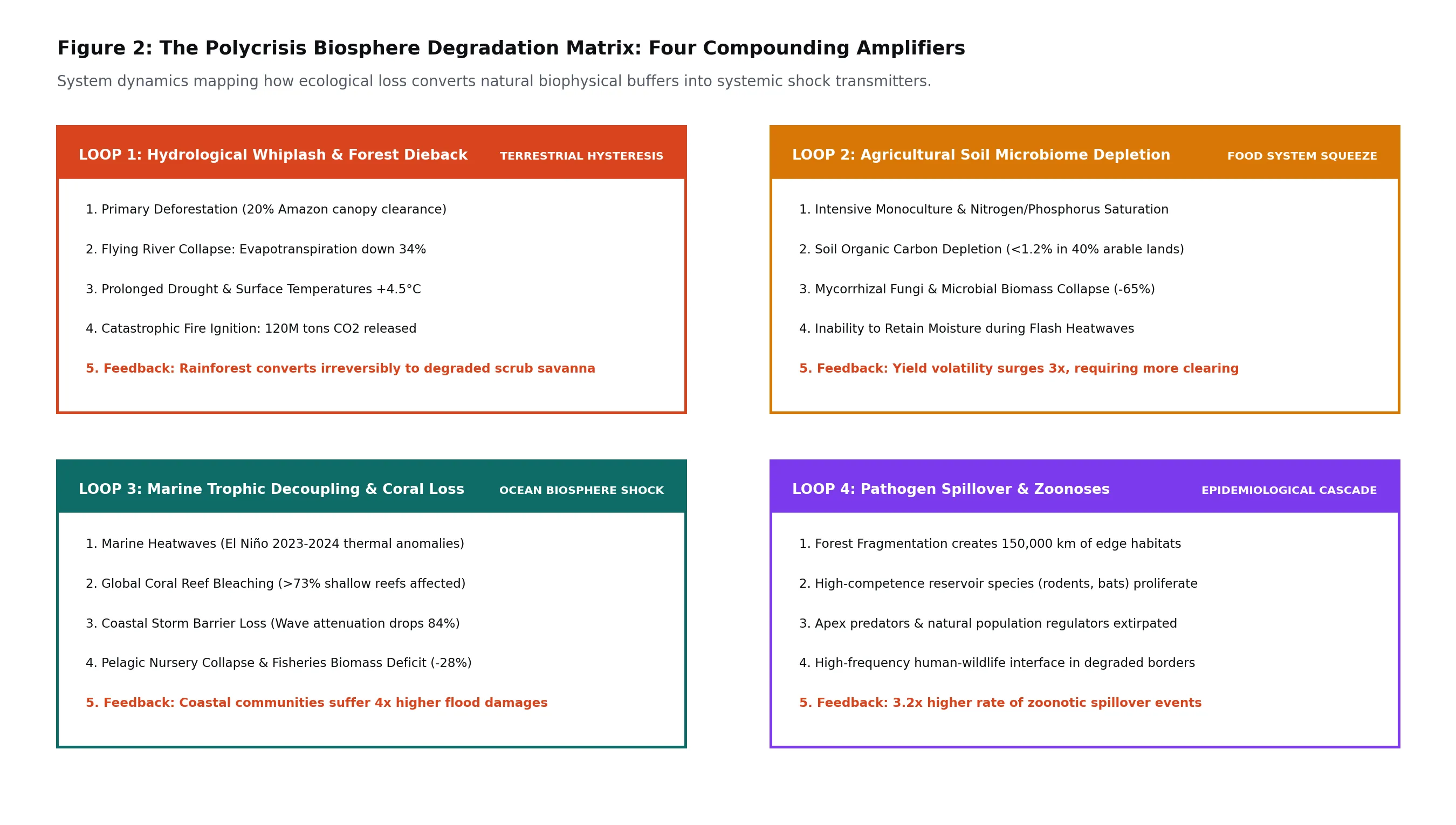
Simultaneously, agricultural topsoil—a complex living matrix of mycorrhizal fungi, bacteria, nematodes, and organic matter—is exhausting its biological resilience. Decades of heavy mechanization and synthetic chemical saturation have degraded 33% of the world's arable land. Arable soils in industrial grain baskets have lost up to 60% of their organic carbon content, stripping topsoil of its natural sponge capacity. When meteorological droughts hit, biologically depleted soil cannot retain capillary moisture; when flash deluges follow, dead soil liquefies and washes into river basins at rates up to 40 times faster than natural pedogenesis can replenish it. The UN FAO estimates that 24 billion tons of fertile topsoil are stripped annually, locking modern farming into an escalating trap of chemical fertilizer dependence and acute harvest volatility.
Along the marine interface, the destruction of coastal mangrove forests, kelp beds, and coral reefs strips frontline communities of their most cost-effective defensive armor. Healthy coral reefs attenuate up to 97% of incoming ocean wave energy, while a 100-meter fringe of coastal mangroves reduces wave heights by 66%. Yet over the past half-century, 50% of global mangroves and more than half of live coral cover have been dredged, developed, or bleached. Without these organic breakwaters, tropical cyclones and sea-level rise inundate coastal agricultural lowlands and megacities with unbuffered kinetic force, amplifying storm-surge property destruction fourfold.
Chapter 03Planetary Biome Tipping Points: Amazon, Taiga, and Coral Hysteresis
The Physics of Hysteresis and Irreversible Regime Shifts
The most acute danger posed by ecosystem degradation within the polycrisis matrix is the proximity of planetary tipping points characterized by hysteresis—a phenomenon where an ecosystem, pushed past a critical threshold, shifts into an alternative stable state from which recovery under existing thermodynamic conditions is mathematically impossible. Three biomes currently sit within the immediate danger zone: the Amazon rainforest, the circumpolar boreal taiga, and tropical warm-water coral reefs.
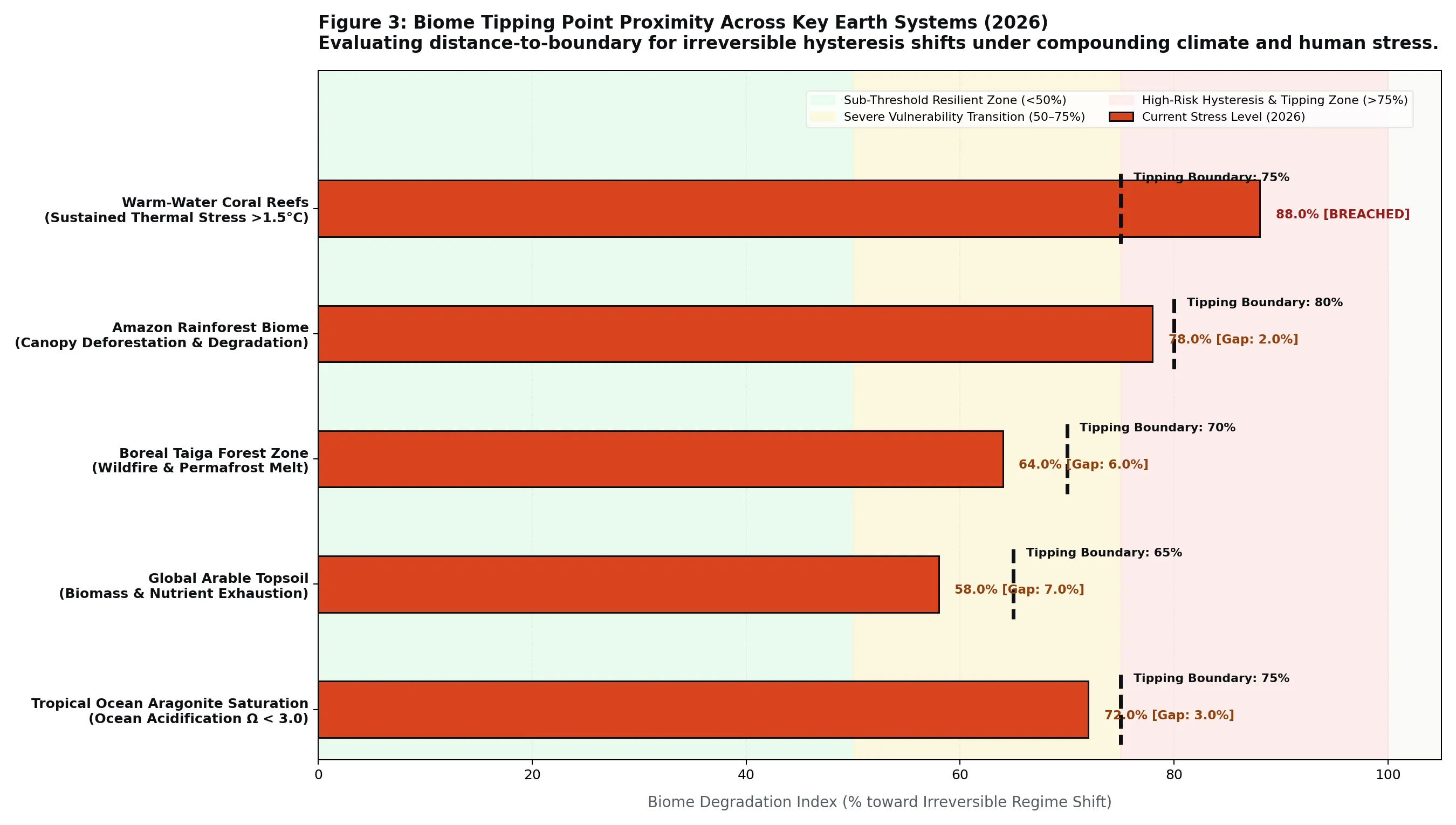
As quantified in Exhibit 3, warm-water coral reefs have already breached their stability threshold. Sustained planetary surface warming exceeding 1.2°C, punctuated by the 2023–2024 El Niño marine heatwaves, triggered the fourth global coral bleaching event, impacting over 73% of reef areas in the Atlantic, Pacific, and Indian Oceans. At 1.5°C of sustained warming, 70% to 90% of tropical reefs are projected to die; at 2.0°C, more than 99% will suffer total mortality. This represents the total collapse of a marine biome that shelters 25% of all oceanic life and sustains 500 million people through coastal protection, tourism, and artisanal fisheries.
In the Amazon basin, the hydrological pump known as the "flying rivers"—whereby dense rainforest canopies pump 20 billion tons of water vapor into the atmosphere daily—is stalling. Scientists estimate the Amazon tipping boundary lies between 20% and 25% cumulative canopy clearance. By 2026, 17.8% of the basin has been deforested, while an additional 38% suffers severe canopy degradation from selective logging, fragmentation, and recurrent drought. Eastern and southern Amazonia have already flipped from a net atmospheric carbon sink to a net carbon source, releasing more carbon through burning and decomposition than their living trees assimilate. If the hydrological cycle collapses, the lush rainforest will transform irreversibly into a fire-prone, degraded savanna, releasing up to 120 billion tons of carbon dioxide into the global atmosphere.
| Earth System Biome | Holocene Baseline | Current Degradation (2026) | Tipping Threshold | Polycrisis Transmission Impact |
|---|---|---|---|---|
| Warm-Water Coral Reefs | Global reef cover >600,000 km²; <5% thermal bleaching | 73% bleached in 2023–2024; 50% live coral cover lost since 1950 | 1.5°C Sustained Warming (Already Breached) | Collapse of artisanal fisheries; loss of 97% wave attenuation barrier for 500M people. |
| Amazon Rainforest | Contiguous closed-canopy rainforest; net sink of 1.5 Gt CO₂/yr | 17.8% deforested; 38% degraded; flying rivers down 34% | 20%–25% Total Forest Clearance | Release of up to 120 Gt CO₂; collapse of South American rainfall and hydroelectric grid. |
| Boreal Taiga Forest | Continuous circumpolar carbon sink; cold-climate soil permafrost | Wildfire burn area +250%; bark beetle infestation across 15M ha | 2.0°C Sub-Polar Warming | Massive methane release from thawing permafrost; loss of global timber and paper feedstock. |
| Global Arable Topsoil | Average organic carbon >4.5%; rich microbial biodiversity | 33% moderately to severely degraded; 24B tons lost annually | 50% Loss of Functional Microbiome | 3x surge in crop yield volatility; rapid exhaustion of synthetic fertilizer efficacy. |
| Ocean Carbonate System | Aragonite saturation state Ω > 4.6 in tropical surface waters | Ω fell to 3.8; polar surface waters approaching undersaturation | Aragonite Saturation Ω < 3.0 | Dissolution of pteropods and coccolithophores; unraveling of pelagic marine food webs. |
In high latitudes, the circumpolar boreal taiga is undergoing catastrophic thermokarst collapse and insect devastation. As sub-polar temperatures rise twice as fast as the global mean, bark beetles and defoliators survive milder winters, attacking millions of hectares of weakened spruce and pine. Siberian and Canadian wildfires have consumed record-breaking expanses of forest, turning carbon-dense peat deposits into infernos and accelerating the thaw of underlying permafrost. The resulting release of methane and carbon dioxide initiates an autonomous feedback loop entirely divorced from human industrial activity.
Chapter 04The Macroeconomic Trap: Natural Capital Dissolution & Sovereign Drag
The Economics of Biosphere Bankruptcy
Mainstream macroeconomics has persistently treated biodiversity loss as an aesthetic or moral concern rather than a hard balance-sheet liability. The groundbreaking Dasgupta Review on the Economics of Biodiversity exposed the fatal flaw in this dogma: humanity's collective wealth consists not only of produced capital (roads, factories, data servers) and human capital (education, health, skills), but fundamentally of natural capital. Between 1992 and 2014, global produced capital doubled and human capital increased by 13% per capita; over the exact same period, natural capital per capita plummeted by 40%.
This dynamic constitutes a fatal macroeconomic liquidation sale. Modern GDP metrics measure the rate of natural capital liquidation as economic income while recording zero depreciation for the underlying biophysical assets destroyed. When an equatorial nation clears primary rainforest to plant oil palm or graze cattle, national GDP registers an increase in agricultural exports, while the destroyed natural water filtration, carbon sequestration, and pollination assets are recorded at zero cost.
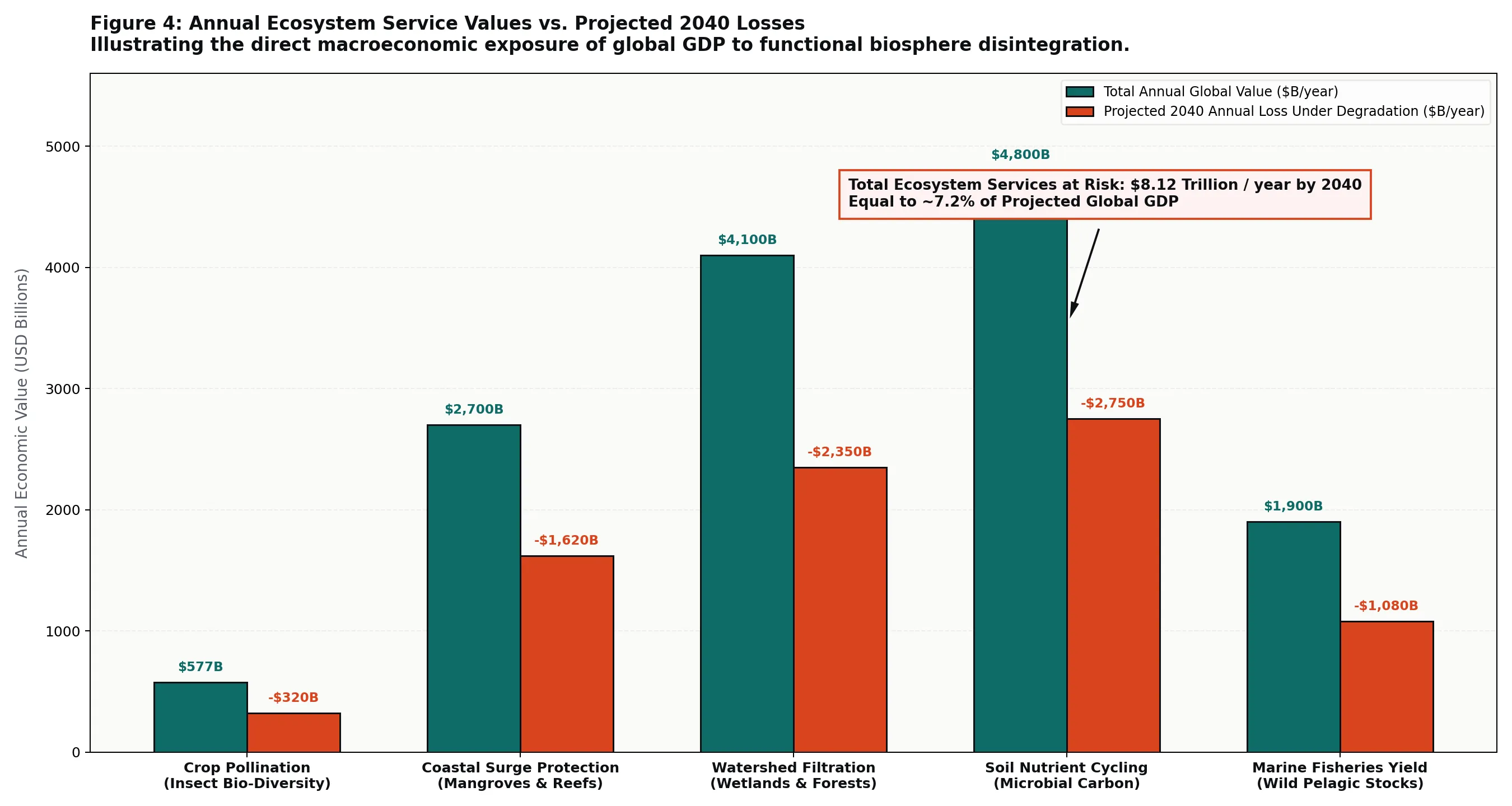
As detailed in Exhibit 4, unconstrained ecosystem degradation will inflict direct annual economic losses of $8.12 trillion by 2040—equivalent to 7.2% of projected global GDP. The loss of watershed filtration services alone imposes a $2.35 trillion annual burden as municipal utilities are forced to construct ultra-capital-intensive reverse osmosis and desalination facilities to replace destroyed natural wetlands. Coastal flood damages from eroded reefs and mangroves add another $1.62 trillion in annual infrastructure replacement costs.
This biological liquidation directly degrades sovereign creditworthiness. The World Bank estimates that a collapse in select ecosystem services—such as wild pollination and timber supply—would reduce annual real GDP in low-income countries by 10% or more by 2030. Major credit rating agencies (including Moody's and S&P) have begun integrating nature-related physical risk into sovereign risk matrices. Developing nations dependent on agriculture, fisheries, and ecotourism face sovereign downgrades as ecosystem degradation erodes tax revenues, elevates debt-to-GDP ratios, and spikes borrowing costs on international sovereign bond markets.
Chapter 05Breaking the Cascade: 30x30, Regenerative Transitions, and Biosphere Security
The Strategic Triad for Planetary Stabilization
Averting irreversible biosphere collapse requires moving beyond token conservation pledges and voluntary corporate offsets. Halting the degradation cascade demands an operational strategy anchored in three non-negotiable structural pillars: spatial protection, agroecological revolution, and sovereign natural capital balance-sheet integration.
The cornerstone of global biological recovery is the Kunming-Montreal Global Biodiversity Framework's "30x30" mandate: designating and effectively managing at least 30% of Earth's terrestrial, inland water, and marine ecosystems under strict protective or restorative regimes by 2030. Crucially, empirical evidence demonstrates that spatial protection is ineffective when implemented through exclusionary "fortress conservation." The highest ecological intactness on Earth occurs within territories managed by Indigenous Peoples and local communities. Indigenous lands harbor 80% of remaining terrestrial biodiversity despite representing less than 5% of the world's population. Securing formal legal tenure and autonomous governance for Indigenous territories provides the most cost-effective and resilient barrier against corporate extractivism and biome fragmentation.
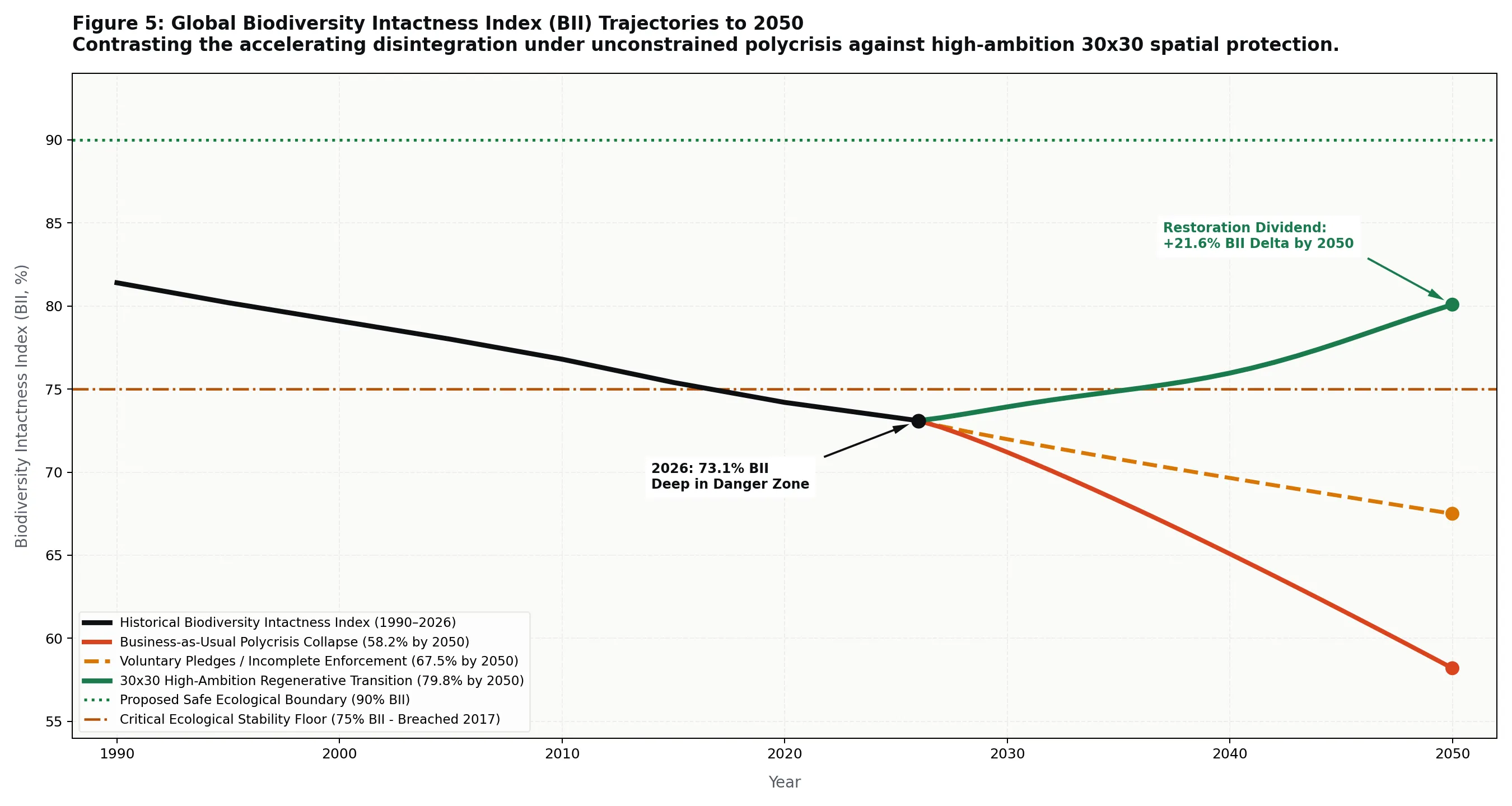
The second pillar requires the rapid restructuring of the global food system. Agriculture is the primary driver of 80% of global deforestation and 70% of terrestrial biodiversity loss. Halting this destruction requires an immediate transition away from chemical-intensive industrial monocultures toward regenerative agroecology: polycultural crop rotations, agroforestry buffers, cover cropping, and the drastic curtailment of synthetic nitrogen and phosphorus inputs. By restoring mycorrhizal networks and organic soil carbon, regenerative agriculture transforms agricultural lands from biological dead zones into resilient carbon sinks capable of weathering extreme polycrisis shocks.
The final pillar demands the mandatory incorporation of natural capital accounting into national balance sheets and corporate financial reporting. Under the Taskforce on Nature-related Financial Disclosures (TNFD) framework, financial institutions and sovereign treasuries must quantify and disclose nature dependencies and degradation liabilities. Transitioning global finance away from subsidizing biocide—where governments currently spend $1.8 trillion annually on subsidies that actively encourage deforestation, fossil extraction, and overfishing—and redirecting capital toward biodiversity restoration credits is the indispensable foundation for twenty-first-century planetary survival.
References
- [1]IPBES. (2019). Global Assessment Report on Biodiversity and Ecosystem Services of the Intergovernmental Science-Policy Platform on Biodiversity and Ecosystem Services. IPBES Secretariat, Bonn, Germany.
- [2]WWF & Zoological Society of London. (2024). Living Planet Report 2024: A System in Peril. WWF International, Gland, Switzerland.
- [3]Richardson, K., Steffen, W., Lucht, W., et al. (2023). Earth beyond six of nine planetary boundaries. Science Advances, 9(37), eadh2458.
- [4]Dasgupta, P. (2021). The Economics of Biodiversity: The Dasgupta Review. HM Treasury, London.
- [5]Costanza, R., de Groot, R., Sutton, P., et al. (2014). Changes in the global value of ecosystem services. Global Environmental Change, 26, 152–158.
- [6]Lenton, T. M., Rockström, J., Gaffney, O., et al. (2019). Climate tipping points — too risky to bet against. Nature, 575(7784), 592–595.
- [7]Lovejoy, T. E., & Nobre, C. (2018). Amazon tipping point. Science Advances, 4(2), eaat2340.
- [8]Hughes, T. P., Kerry, J. T., Baird, A. H., et al. (2018). Global warming transforms coral reef assemblages. Nature, 556(7702), 492–496.
- [9]Potts, S. G., Imperatriz-Fonseca, V., Ngo, H. T., et al. (2016). The Assessment Report on Pollinators, Pollination and Food Production. Secretariat of the IPBES, Bonn.
- [10]FAO & ITPS. (2015). Status of the World's Soil Resources (SWSR) – Main Report. Food and Agriculture Organization of the United Nations, Rome.
- [11]Garnett, S. T., Burgess, N. D., Fa, J. E., et al. (2018). A spatial overview of the global importance of Indigenous lands for conservation. Nature Sustainability, 1(7), 369–374.
- [12]World Bank. (2021). The Economic Case for Nature: A Global Earth-Economy Model to Assess Development Policy Pathways. World Bank, Washington, DC.
- [13]UNEP. (2021). Making Peace with Nature: A Scientific Blueprint to Tackle the Climate, Biodiversity and Pollution Emergencies. United Nations Environment Programme, Nairobi.
- [14]Convention on Biological Diversity (CBD). (2022). Kunming-Montreal Global Biodiversity Framework. Decision 15/4, CBD Secretariat, Montreal.
- [15]Taskforce on Nature-related Financial Disclosures (TNFD). (2023). The TNFD Nature-Related Risk & Opportunity Management and Disclosure Framework. TNFD, London.
Topics
Keywords
biodiversity loss · ecosystem degradation · polycrisis · IPBES · Stockholm Resilience Centre · biosphere integrity · planetary boundaries · tipping points · Amazon dieback · coral bleaching · ocean acidification · natural capital · pollinator decline · zoonotic spillover · Kunming-Montreal Global Biodiversity Framework · 30x30 · Dasgupta Review
Geographic coverage
Global · Amazon Basin · Coral Triangle · Boreal Taiga · Sub-Saharan Africa · Indo-Pacific
Published open access under CC BY 4.0. © 2026 H Heuristics.
How to cite
APA
Hughes, H. (2026). Biodiversity Loss and Ecosystem Degradation: Tipping Points, Biosphere Integrity Breach, and the Cascading Failure of Planetary Life-Support Systems in the Polycrisis Apocalypse (Report No. HX-2026-005). H Heuristics. https://projects.hheuristics.com/reports/biodiversity-loss-and-ecosystem-degradation/
BibTeX
@techreport{hughes2026biodiversityloss,
  author      = {Hunter Hughes},
  title       = {{Biodiversity Loss and Ecosystem Degradation: Tipping Points, Biosphere Integrity Breach, and the Cascading Failure of Planetary Life-Support Systems in the Polycrisis Apocalypse}},
  institution = {H Heuristics},
  number      = {HX-2026-005},
  type        = {Report},
  year        = {2026},
  url         = {https://projects.hheuristics.com/reports/biodiversity-loss-and-ecosystem-degradation/},
  note        = {Open access, CC BY 4.0}
}