Report · Digital edition
Poverty, Inequality, and the Development Trap
Asymmetric Hazard Exposure, Capital Cannibalization, and the Collapse of Economic Convergence in the Polycrisis Apocalypse
Abstract
Poverty and economic inequality are conventional developmental metrics, but in the polycrisis apocalypse, they function as fatal multipliers of biophysical hazard. As established by the IPCC, identical physical shocks—from extreme heat domes to flash deluges—produce radically divergent outcomes across wealth tiers. In vulnerable developing economies, low incomes, unpaved infrastructure, and informal housing strip populations of adaptive shielding, transforming manageable meteorological events into catastrophic mortality, preventable disease, and educational disruption. At the macroeconomic level, recurrent disaster reconstruction cannibalizes gross fixed capital formation, while international bond markets impose a 200–500 basis point borrowing penalty on climate-vulnerable sovereigns. This monograph analyzes the structural mechanics of the climate-development trap across five focused chapters, five empirical exhibits, and master comparative data tables, presenting a capital-backed strategy for universal basic infrastructure and debt de-risking.
- 5
- Chapters
- 5
- Exhibits
- 1
- Data tables
- 14
- References
Key insights
- Physical climate hazards do not determine societal disaster; human vulnerability and state capacity dictate survival. As the IPCC confirms, an identical weather event produces fifteen times higher mortality in low-income, infrastructure-deficient settings than in fortified economies.
- Poverty functions as an acute absence of protective physical shielding. Low-income urban households living beneath uninsulated corrugated tin roofs experience indoor thermal spikes up to 8°C higher than ambient outdoor temperatures, turning urban heatwaves into lethal domestic traps.
- Compounding sub-threshold shocks inflict severe intergenerational damage. When heatwaves and floods destroy informal livelihoods, families exhaust meager savings on private tanker water and food inflation, forcing children out of school and permanently depressing lifelong human capital.
- The climate-development trap derails macroeconomic convergence. Recurrent physical asset destruction forces developing sovereigns to reallocate scarce tax revenues from new infrastructure investments into emergency repair, permanently cannibalizing gross fixed capital formation.
- International financial markets impose a punitive 200 to 500 basis point borrowing penalty on climate-vulnerable sovereigns. This cost-of-capital divide starves low-income nations of the affordable financing required to construct climate-resilient water, power, and transport networks.
- Without radical multilateral debt restructuring and universal basic infrastructure, the polycrisis accelerates an attritional 'Global Haiti' dynamic. Repair costs exceed sovereign administrative bandwidth, collapsing formal governance and locking frontline populations into irreversible poverty traps.
Chapter 01The Asymmetry of Impact: Hazard vs. Vulnerability
The Social Physics of Disproportionate Destruction
For decades, conventional environmental discourse framed natural hazards as great levelers—acts of nature that strike across social divides without distinction. In the crucible of the twenty-first-century polycrisis, this myth has been thoroughly shattered. Natural hazards are physical phenomena; disasters are fundamentally socio-economic constructs. Within the converging stress matrix of climate instability, resource depletion, and economic fracture, poverty and inequality act as aggressive force multipliers that translate meteorological fluctuations into catastrophic human dissolution.
The definitive synthesis established by the Intergovernmental Panel on Climate Change (IPCC) in its Sixth Assessment Report underscores this divergence: human vulnerability is not an incidental modifier of risk, but its primary determinant. Over the past decade, populations living in regions classified as highly vulnerable—encompassing vast swaths of Sub-Saharan Africa, South Asia, Central America, and small island developing states—experienced a fifteen-fold higher mortality rate from extreme floods, droughts, and storms compared to populations in low-vulnerability regions. The physical hazard may be identical, but the human outcome is governed entirely by accumulated capital, protective infrastructure, and administrative state capacity.
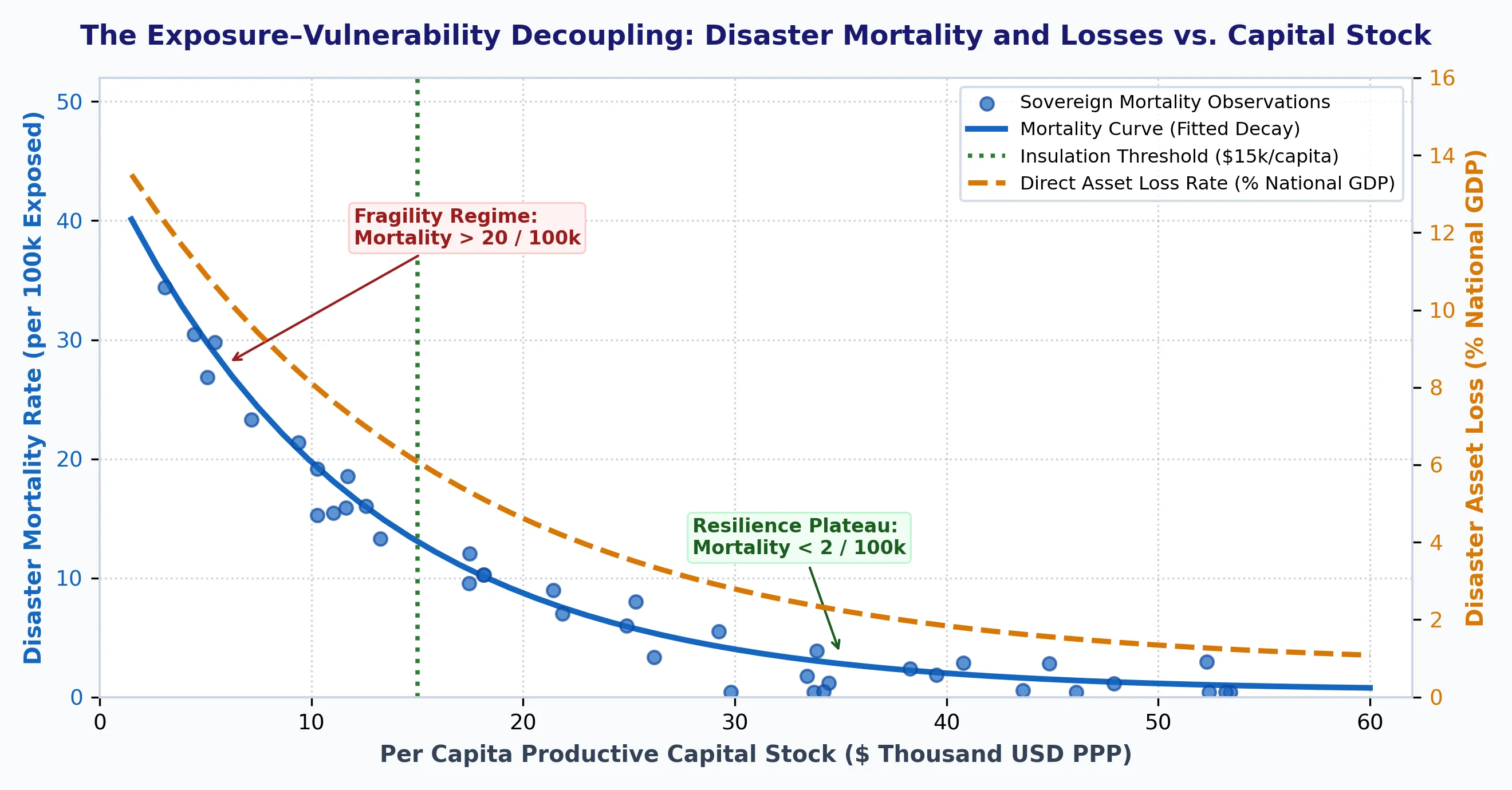
Consider the divergent physics of a 42°C heatwave across an unequal metropolitan landscape. In affluent districts, residents retreat behind sealed, high-efficiency building envelopes cooled by continuous HVAC systems powered by prioritized electrical grids. They maintain continuous hydration through municipal piped connections, preserve fresh nutrition in hermetic refrigeration, and access rapid tertiary medical intervention at the earliest onset of heat exhaustion. Mortality is statistically negligible.
Less than three kilometers away in an informal settlement, the exact same meteorological event is transformed into a physiological trap. High-density shanties constructed from uninsulated corrugated iron and cinder blocks function as thermal ovens, trapping radiative solar heat and elevating indoor ambient temperatures up to 8°C above outdoor levels. Without grid electricity for mechanical cooling, without running water to offset evaporative fluid loss, and with open-drain sewage evaporating into stagnant, toxic airsheds, vulnerable infants and elderly residents succumb rapidly to heatstroke, acute cardiovascular collapse, and kidney failure. Inequality converts a weather anomaly into a mass-casualty event.
Chapter 02Compounding Micro-Amplifiers: Health, Education, and Labor Attrition
The Erosion of the Human Capital Foundation
The true brutality of the polycrisis lies not merely in peak catastrophic events, but in the attritional grind of sub-threshold compound shocks that systematically cannibalize household resilience. For the nearly four billion people globally who subsist between extreme poverty ($2.15/day) and vulnerable lower-middle-income status ($6.85/day), life is lived on a razor-thin biophysical margin. They possess neither financial savings, formal health insurance, nor liquid assets capable of absorbing multi-domain stress.
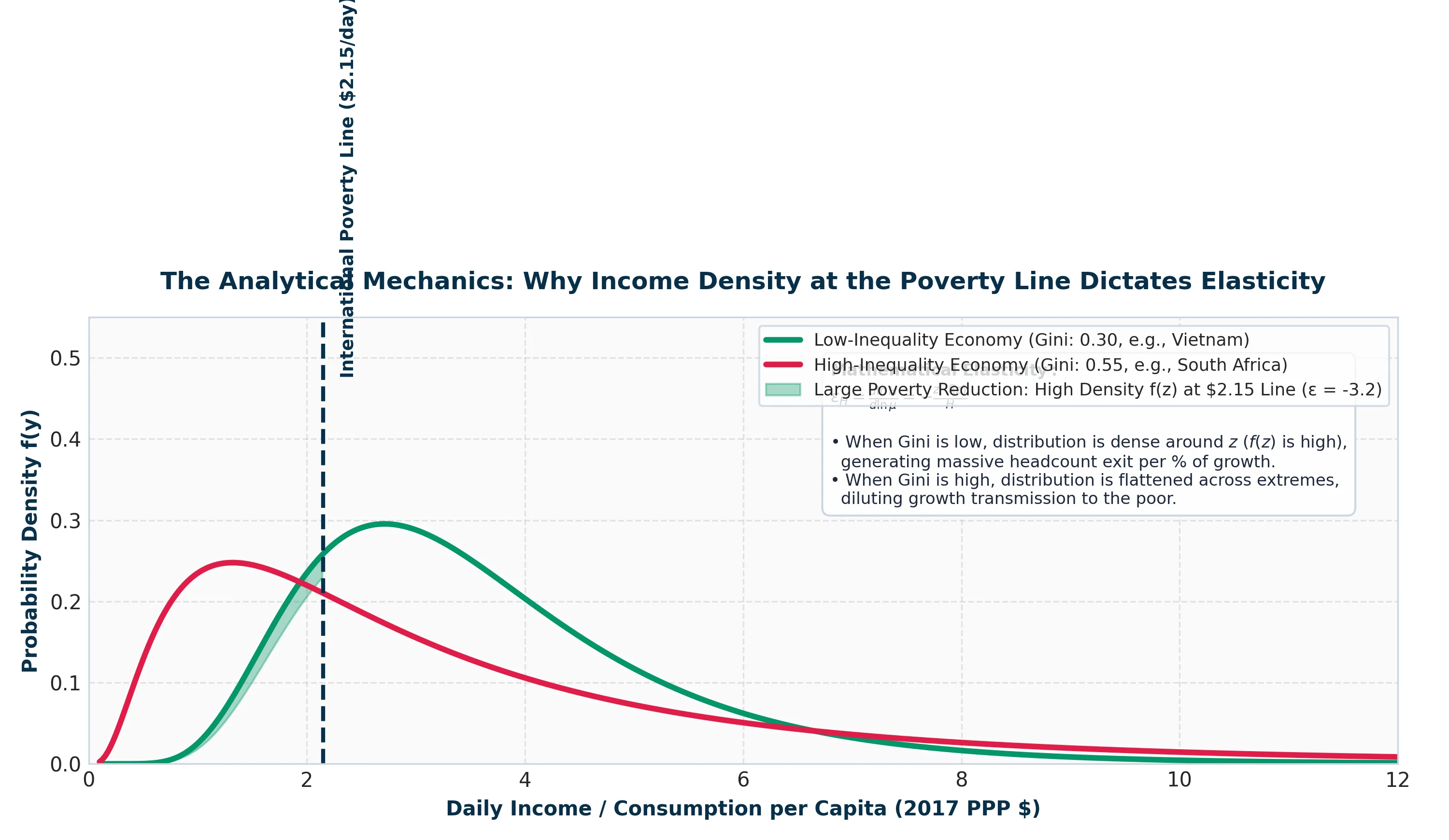
When localized environmental shocks strike, the transmission mechanisms cascade through household microeconomics with terrifying predictability:
- The Water-Energy Price Squeeze: Municipal distribution failures force low-income households to purchase potable water from informal tanker cartels, paying up to twenty times more per liter than connected wealthy households. In megacities such as Karachi, Nairobi, and Lima, water and energy expenditures consume between 20% and 35% of daily household income during seasonal droughts.
- Labor Productivity Decapitation: Because poor laborers are overwhelmingly concentrated in climate-exposed occupations—manual agriculture, informal construction, street vending, and day labor—ambient wet-bulb temperature surges force direct curtailment of working hours. A three-week heatwave reduces monthly earnings by up to 40%, instantly plunging food-secure families into acute caloric deficits.
- Preventable Morbidity & Medical Debt: Stagnant floodwaters and intermittent water piping cause rapid microbial proliferation, triggering surges in waterborne diarrheal diseases, cholera, and vector-borne dengue fever. Out-of-pocket medical expenditures for emergency clinic visits and rehydration salts force families into the clutches of informal predatory moneylenders charging interest rates exceeding 100% per annum.
- Intergenerational Educational Disruption: To service emergency debt and compensate for lost adult wages, households withdraw elder children from school to enter informal labor, while girls are diverted into daily domestic water-hauling labor. The destruction of educational continuity permanently suppresses the cognitive and economic development of the next generation.
Chapter 03The Macroeconomic Trap: Capital Cannibalization & Sovereign Risk
Why Neoclassical Convergence Is Stalling
For more than half a century, neoclassical growth theory operated on a core dogma: capital scarcity in developing economies guarantees higher marginal returns on investment, naturally attracting capital inflows that accelerate economic catch-up with advanced nations. In the polycrisis era, this convergence flywheel has ground to a halt. Developing sovereigns find themselves trapped in an inescapable macroeconomic vise: physical climate destruction systematically destroys productive capital, while global financial markets impose prohibitive borrowing penalties that starve developing states of the funds needed to adapt.
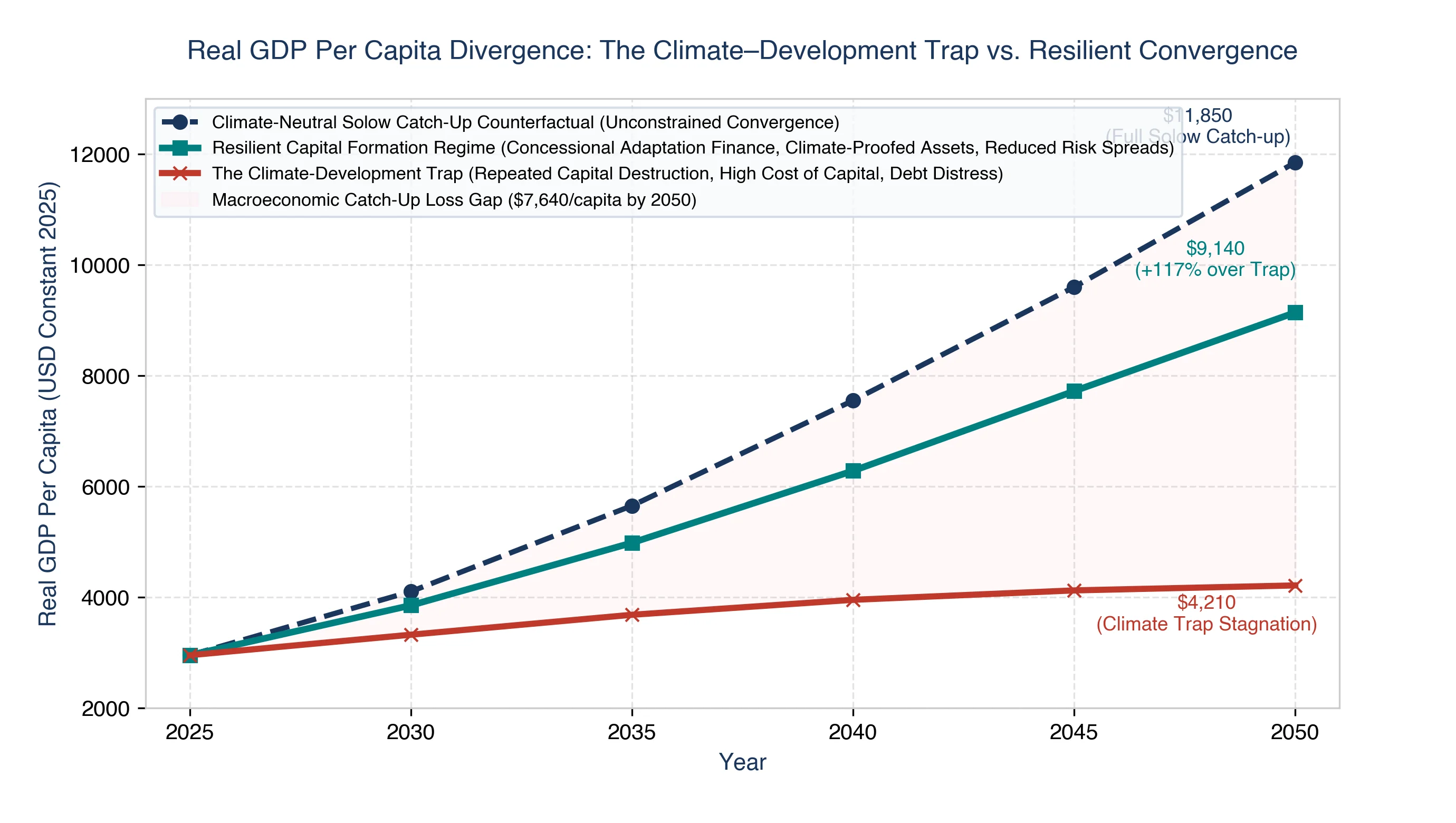
This trap operates through two powerful macroeconomic levers: capital cannibalization and the cost-of-capital divide. Standard growth accounting assumes a constant, manageable rate of capital depreciation (typically 4% to 6% per annum). But when recurrent tropical cyclones, flash floods, and coastal storm surges obliterate national road networks, bridge spans, electrical substations, and port terminals, the effective depreciation rate spikes to 12% or higher. National treasuries are forced into continuous fiscal triage, diverting scarce revenue away from discretionary Gross Fixed Capital Formation (GFCF)—such as universities, fiber networks, and modern hospitals—merely to rebuild yesterday's washed-out culverts.
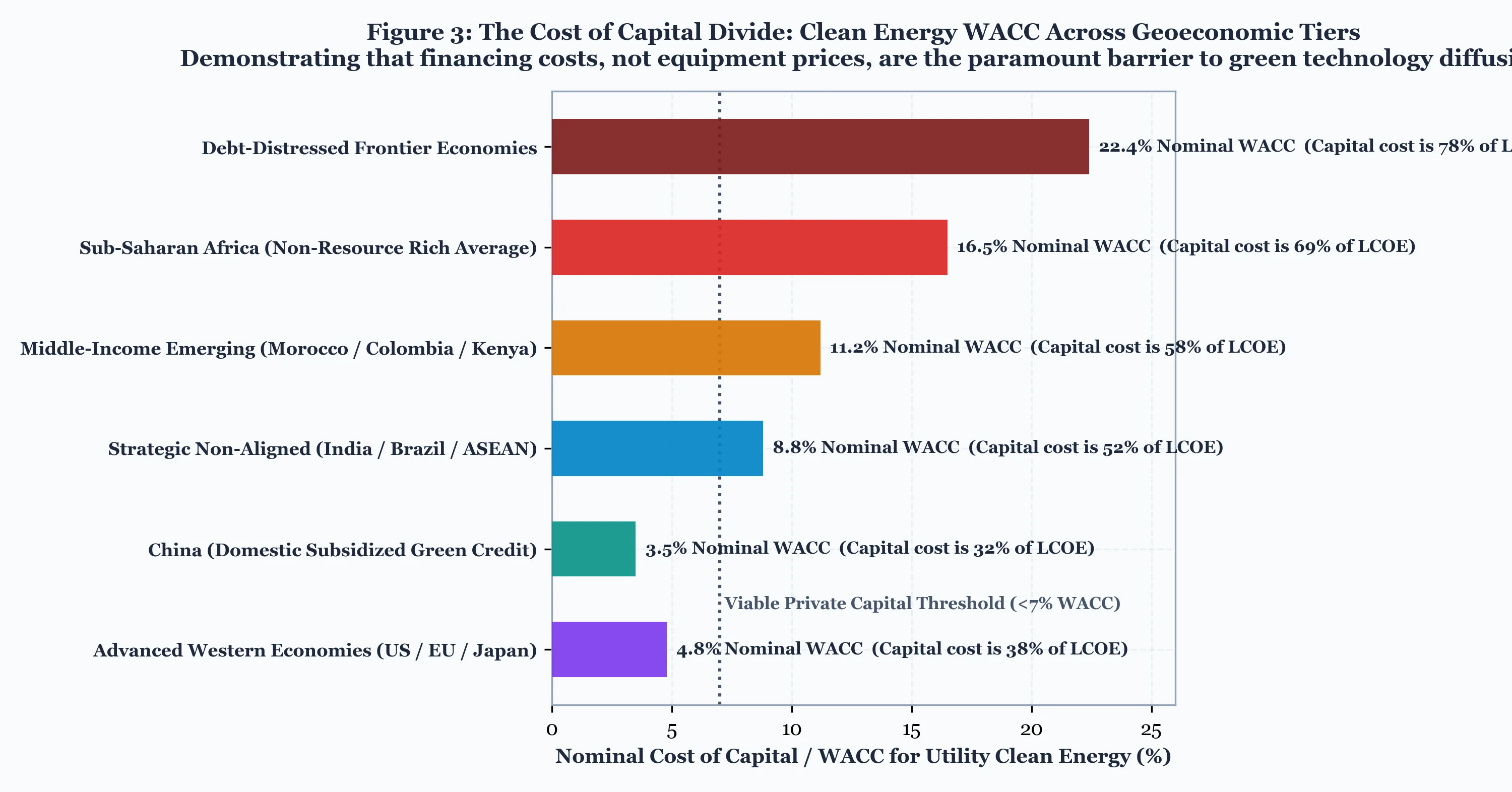
Simultaneously, international credit rating agencies and global bond markets price physical climate vulnerability directly into sovereign spreads. Empirical audits by the V20 Group of Climate Vulnerable Economies demonstrate that climate-exposed developing sovereigns pay an average borrowing premium of 200 to 500 basis points over benchmark debt yields. While an advanced sovereign finances long-term coastal defenses at 2% to 3%, a vulnerable sovereign must pay 11% to 15% for identical capital equipment. The very physical vulnerability that necessitates adaptation capex makes that capex commercially unaffordable, locking developing economies into an accelerating trajectory of sovereign divergence.
Chapter 04The Polycrisis Endpoint: The Attritional 'Global Haiti' Dynamic
The Exhaustion of Administrative State Capacity
When microeconomic human capital depletion and macroeconomic capital cannibalization interact over sustained time horizons, they generate the defining systemic condition of the polycrisis apocalypse: the collapse of state administrative bandwidth. Coined by H Heuristics, the 'Global Haiti' dynamic designates a terminal development regime wherein the cumulative rate of biophysical stress permanently outpaces the institutional repair capacity of the state.
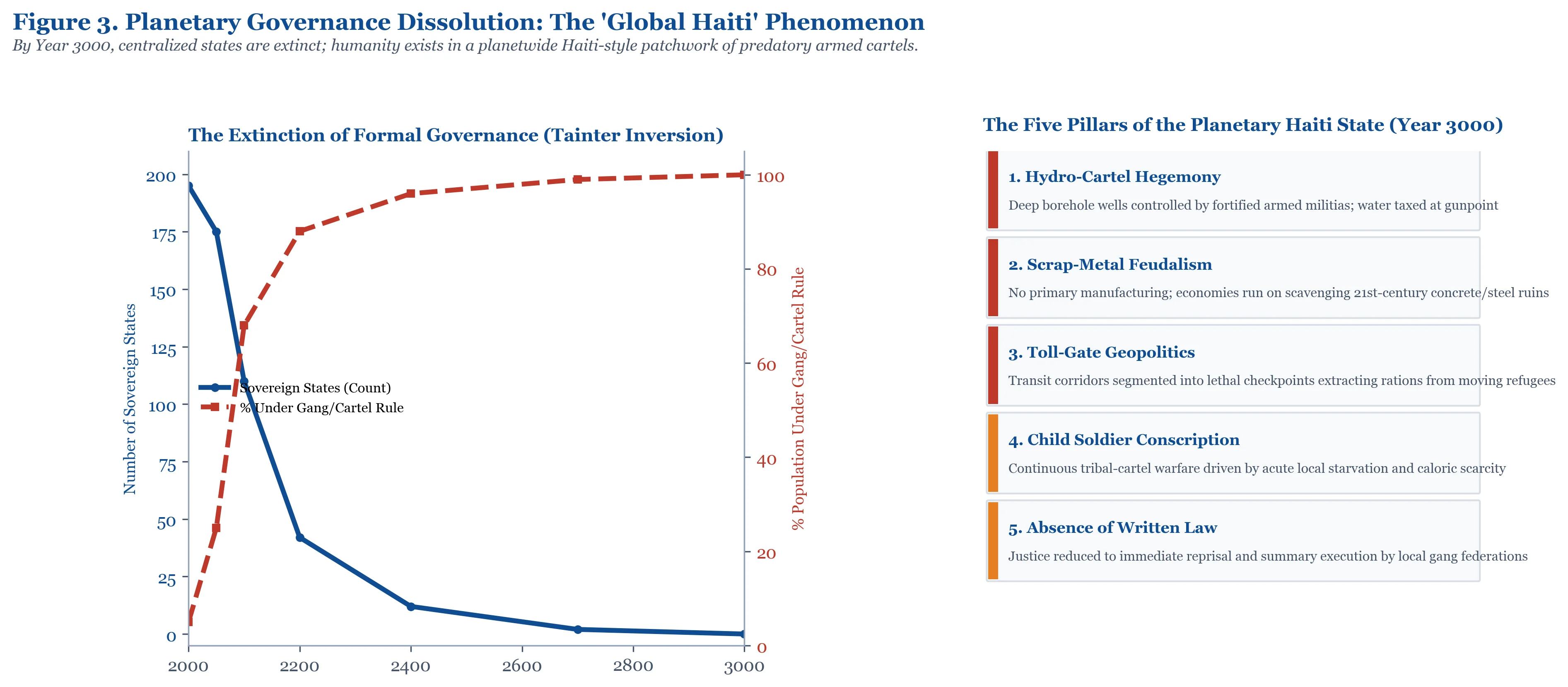
In this regime, civilizational decline does not occur through instantaneous collapse, but through an attritional ratchet of institutional degradation. As tax collections wither and debt service consumes upwards of 40% of national revenues, the central government is forced to abandon the physical periphery. Municipal water boards cease pipeline maintenance; national electric utilities abandon rural feeder repairs; public schools close; and national police forces withdraw to protect capital enclaves.
The resulting vacuum is swiftly occupied by illicit non-state armed actors, extortion syndicates, and tanker mafias who monetize the basic biological needs of the desperate population. Once this tipping point is breached, formal state capacity ceases to exist, and external climate shocks trigger immediate sovereign insolvency, armed factionalism, and mass distress migration. The society transitions from an emerging economy on a convergence trajectory into a permanent humanitarian containment zone.
| Structural Indicator | Low-Income Fragile Sovereign | Middle-Income Developing Sovereign | Advanced Fortified Economy |
|---|---|---|---|
| Indoor Thermal Exposure Penalty | +6°C to +8°C (Tin / Informal Roofing) | +2°C to +4°C (Concrete / Mixed Materials) | -10°C to -15°C (Continuous High-Efficiency HVAC) |
| Water Access During Severe Drought | Informal Tanker Cartels (15–20x Cost) | Rationed Piped Grid / Intermittent Supply | Continuous Pressurized Municipal Utility |
| Average Cost of Capital (WACC) | 11.5% – 16.0% Sovereign Bond Yields | 6.5% – 9.0% Blended Sovereign Spreads | 1.8% – 3.2% Benchmark Debt Yields |
| Gross Capital Cannibalization Rate | 55%–70% of Capex Diverted to Repair | 25%–35% of Capex Diverted to Repair | <5% of Capex Diverted to Disaster Repair |
| Humanitarian Mortality Multiplier | 15.2x Baseline Climate Hazard Mortality | 3.8x Baseline Climate Hazard Mortality | 1.0x Baseline (Shielded Reference Standard) |
| Institutional Repair Bandwidth | Exhausted / Territorial Fragmentation | Severely Strained / Chronic Fiscal Deficits | Fully Solvent / Redundant Strategic Reserves |
Chapter 05Breaking the Trap: Strategic Priorities for Resilient Convergence
A Capital-Backed Architecture for Universal Shielding
Escaping the climate-development trap is mathematically impossible through traditional incremental developmental assistance. Reversing the polycrisis ratchet demands a radical re-engineering of global public finance and the rapid, decentralized deployment of Universal Basic Infrastructure (UBI-Infra) across frontline jurisdictions. Three structural interventions form the indispensable core of this defense:
- Universal Basic Infrastructure (UBI-Infra): Rather than pursuing centralized megaprojects vulnerable to single-point failure, capital must fund distributed, modular resilience technologies: off-grid solar microgrids with battery storage, modular reverse-osmosis water kiosks, reflective cool-roof coatings that reduce indoor shanty temperatures by 5°C, and decentralized stormwater bioswales. Providing localized physical shielding restores the biophysical baseline required for human labor productivity.
- Compressing the WACC Divide via Multilateral First-Loss Facilities: Multilateral Development Banks (MDBs) and bilateral climate funds must transition from direct project lending to providing structured credit guarantees and first-loss equity tranches. By absorbing initial downside political and currency volatility, an international guarantee facility can compress the 500 basis point borrowing penalty down to concessionary rates, crowding in institutional pension capital to finance long-term adaptation infrastructure.
- Universal Climate Resilience Debt Pauses: All sovereign and sub-sovereign bilateral debt contracts must integrate automated catastrophe clauses. When an objectively verified satellite telemetry threshold is breached—such as a Category 4 tropical cyclone landfall or an extreme drought soil moisture index—sovereign debt service must freeze automatically for twenty-four months. Halting debt outflows during acute shock windows preserves sovereign foreign exchange reserves, preventing fiscal asphyxiation and eliminating the need for emergency domestic budget cannibalization.
By dismantling the transmission channels linking poverty to catastrophic biophysical exposure, contemporary civilization can break the vicious feedback loops of the polycrisis apocalypse. Fortifying human adaptive capacity is not an act of global charity—it is the foundational strategic investment required to preserve planetary economic stability, maintain international trade networks, and secure the collective future of human development.
References
- [1]Intergovernmental Panel on Climate Change (IPCC). (2022). Climate Change 2022: Impacts, Adaptation, and Vulnerability. Contribution of Working Group II to the Sixth Assessment Report. Cambridge University Press.
- [2]V20 Group of Vulnerable Economies. (2023). Climate Vulnerability and the Sovereign Cost of Capital. Global Center on Adaptation & Climate Vulnerable Forum.
- [3]Hughes, H. (2026). The Architecture of Creation and the Polycrisis Apocalypse: Cascading Earth-System Failure and Human Exposure Traps. H Heuristics Global Strategic Monograph Series.
- [4]World Bank. (2024). Poverty, Prosperity, and Planet Report 2024: Pathways Out of the Polycrisis. World Bank Group, Washington, D.C.
- [5]Stockholm Resilience Centre. (2025). Planetary Boundaries Framework: Human Equity and Earth System Transgression Metrics. Stockholm University.
- [6]Network for Greening the Financial System (NGFS). (2024). Physical Climate Risks and Sovereign Credit Spreads: Financial Telemetry and Macro-Financial Implications. Banque de France.
- [7]Hallegatte, S., Vogt-Schilb, A., Bangalore, M., & Rozenberg, J. (2017). Unbreakable: Building the Resilience of the Poor in the Face of Natural Disasters. World Bank.
- [8]United Nations Human Settlements Programme (UN-Habitat). (2024). World Cities Report 2024: Climate Resilient Urbanization in Informal Settlements. UN-Habitat, Nairobi.
- [9]Carleton, T. A., & Hsiang, S. M. (2016). Social and economic impacts of climate. Science, 353(6304), aad9837.
- [10]Food and Agriculture Organization (FAO). (2025). The State of Food Security and Nutrition in the World: Urban Inequality and Caloric Vulnerability. FAO, Rome.
- [11]International Monetary Fund (IMF). (2025). Fiscal Monitor: Sovereign Debt Under Chronic Environmental Shocks. International Monetary Fund, Washington, D.C.
- [12]Kahn, M. E., Mohaddes, K., Ng, R. N., Pesaran, M. H., Raissi, M., & Yang, J. C. (2021). Long-term macroeconomic effects of climate change: A cross-country analysis. Energy Economics, 104, 105624.
- [13]Hughes, H. (2026). The Cost of Capital Divide: How Sovereign Borrowing Penalties Derail Global Climate Adaptation. H Heuristics Working Papers.
- [14]Stern, N. (2023). A Strategy for Climate and Growth in the Developing World: Finance, Innovation, and State Capacity. London School of Economics, Grantham Research Institute.
Topics
Keywords
poverty · inequality · development trap · polycrisis · IPCC · asymmetric vulnerability · adaptive capacity · capital cannibalization · climate risk premium · WACC divide · sovereign debt · human capital attrition · informal settlements · Global Haiti · economic convergence
Geographic coverage
Global · Sub-Saharan Africa · South Asia · Latin America · Southeast Asia · Small Island Developing States
Published open access under CC BY 4.0. © 2026 H Heuristics.
How to cite
APA
Hughes, H. (2026). Poverty, Inequality, and the Development Trap: Asymmetric Hazard Exposure, Capital Cannibalization, and the Collapse of Economic Convergence in the Polycrisis Apocalypse (Report No. HX-2026-004). H Heuristics. https://projects.hheuristics.com/reports/poverty-inequality-and-the-development-trap/
BibTeX
@techreport{hughes2026povertyinequality,
  author      = {Hunter Hughes},
  title       = {{Poverty, Inequality, and the Development Trap: Asymmetric Hazard Exposure, Capital Cannibalization, and the Collapse of Economic Convergence in the Polycrisis Apocalypse}},
  institution = {H Heuristics},
  number      = {HX-2026-004},
  type        = {Report},
  year        = {2026},
  url         = {https://projects.hheuristics.com/reports/poverty-inequality-and-the-development-trap/},
  note        = {Open access, CC BY 4.0}
}